
Philosophiae Naturalis Principia Mathematica First Edition

Unraveling the Universe: A Chat with Newton's 'Principia'
Imagine you're strolling through the hallowed halls of Cambridge University, circa 1686. You bump into a young, bespectacled Isaac Newton, who's been quietly revolutionizing the world of physics. He hands you a hefty tome, bound in worn leather, titled Philosophiæ Naturalis Principia Mathematica. You raise an eyebrow, "What's this, Isaac?" he grins, "Just a little something I've been working on. It's all about the laws of motion and universal gravitation."
Meet the 'Principia'
The Principia, as it's fondly known, is no ordinary book. It's a scientific masterpiece that laid the groundwork for classical mechanics, shaping our understanding of the universe. It's like the original blueprint for the cosmos, written in elegant Latin and filled with mathematical equations that dance like poetry on the page.
Newton didn't just write this book; he crafted it. Over a decade in the making, the Principia is a testament to his genius and perseverance. It's not just a book; it's a time capsule, a window into the mind of one of history's greatest thinkers.
Must Read
Three Laws to Rule Them All
The Principia introduces us to Newton's three laws of motion, which are as fundamental to physics as the ABCs are to reading. Here's a quick rundown:
- First Law: An object at rest stays at rest, and an object in motion stays in motion, unless acted upon by an external force.
- Second Law: The force acting on an object is equal to its mass times its acceleration.
- Third Law: For every action, there is an equal and opposite reaction.
These laws are so intuitive, yet so powerful, they've become the backbone of modern physics. They're like the secret sauce that makes the universe tick.

Gravity: The Universal Glue
But the Principia isn't just about motion; it's also about gravity. Newton's law of universal gravitation, also introduced in this book, is like the cosmic glue that holds the universe together. It tells us that every particle of matter in the universe attracts every other particle with a force that's directly proportional to the product of their masses and inversely proportional to the square of the distance between their centers.
In simpler terms, it's why the apple fell from the tree, and why the moon orbits the Earth. It's why we don't float off into space, and why the stars stay in their constellations. It's the reason we have tides, and why the planets don't collide in a chaotic dance. It's the ultimate force of nature, the great equalizer that binds us all.
Fun Facts and Cultural References
Did you know that the Principia was so influential, it inspired a wave of scientific exploration and innovation? It's like the original spark that ignited the Enlightenment. It even inspired poets and philosophers, from Alexander Pope to Voltaire, who famously quipped, "God said, 'Let Newton be!' and all was light."
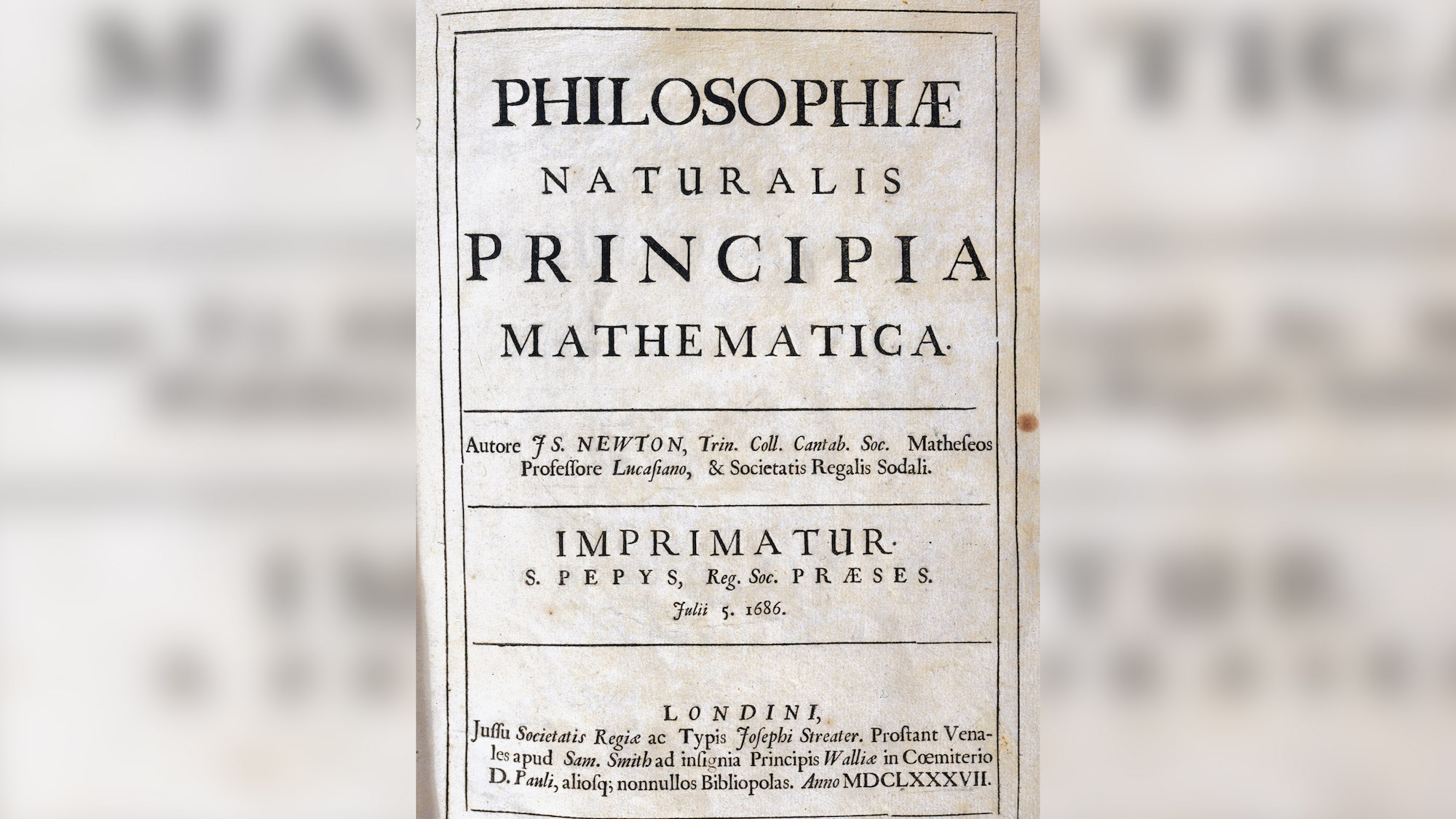
And here's a fun fact: The Principia's first edition was so expensive, only 300 copies were printed, and many were sold at a loss. Newton himself had to pay for the printing costs. Talk about a labor of love!
Newton's Legacy: A Reflection
So, what can we learn from the Principia today? For starters, it's a reminder that great ideas take time. Newton didn't write this book in a flash of inspiration; he spent years honing his theories, perfecting his arguments, and refining his mathematics. It's a testament to the power of persistence and the value of deep, focused work.
But more than that, the Principia is a reminder that the universe is a beautiful, ordered place, governed by elegant, mathematical laws. It's a reminder that we're all connected, bound together by the invisible threads of gravity. It's a reminder that, as Newton himself once said, "What goes up must come down." And sometimes, it comes down in the form of a groundbreaking book that changes the world.