
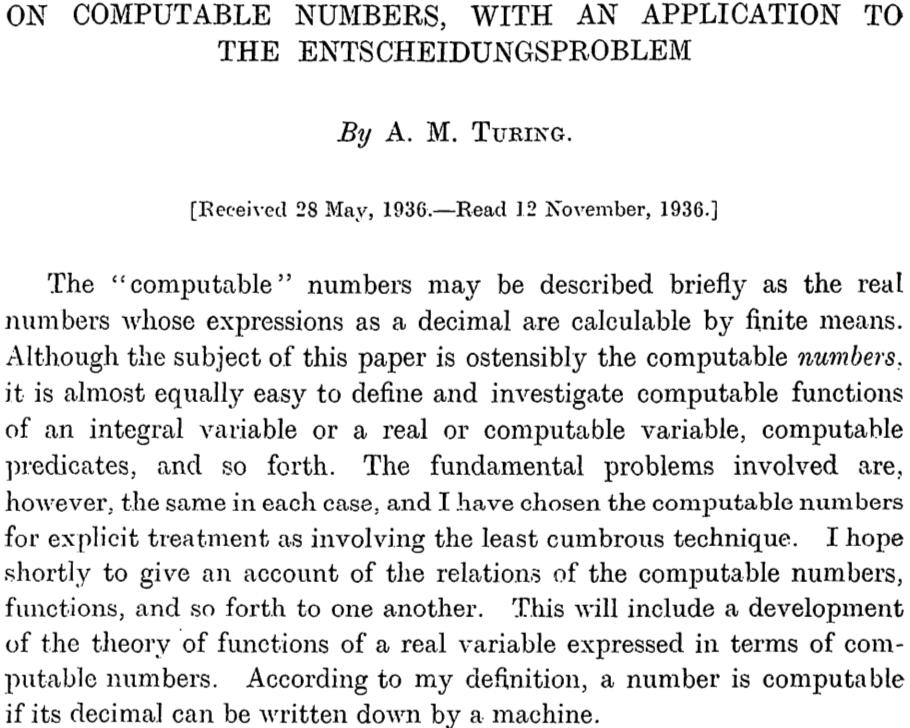
On Computable Numbers With An Application To The Entscheidungsproblem

When Computers Were Still a Twinkle in Dad's Eye
Picture this: it's 1936, and our hero, a young whippersnapper named Alan Turing, is sitting in a room filled with nothing but paper, pencils, and the hum of his own thoughts. No, he's not waiting for his online order of quills and parchment to arrive - he's about to blow the lid off the world of mathematics. And he's not even using a single byte of data!
Enter the Entscheidungsproblem
Now, imagine you're at a party, and someone asks you, "Can we always tell if a mathematical statement is true or false?" You might laugh, down your punch, and say, "Well, I can't even tell if my ex is still single, so good luck with that one!" But this was no laughing matter for the math community. This question, known as the Entscheidungsproblem, was keeping them up at night.
The Entscheidungs part comes from German, meaning 'decision'. The problem was: can we create a mechanical process, or a 'machine', that could decide the truth value of any mathematical statement? Sounds like a job for... oh, I don't know, maybe a computer?
Must Read
Turing's Brainchild: The Universal Machine
Turing, our hero, had a eureka moment. He thought, "What if we could create a machine that could do any calculation, given enough time and resources?" And thus, the universal machine was born - in theory, at least. This machine could simulate any other machine, given the right instructions. It could play chess, write poetry, or even predict the weather (though don't hold your breath on that last one).
But here's the kicker: Turing proved that even this super-machine couldn't solve the Entscheidungsproblem. He showed that there are some mathematical statements that are just plain undecidable - like trying to figure out if your friend's 'vegan' diet is actually just an excuse to eat more cheese.

Turing Machines and Halting Problems
To prove this, Turing introduced the concept of a halting problem. Imagine you're given a machine and a task. You start the machine, and it begins to calculate. Now, you have to predict: will this machine ever stop? If you could always answer 'yes' or 'no', you'd have a way to decide the truth of any mathematical statement. But alas, it's not that simple.
Turing proved that no general method exists to solve the halting problem. In other words, there are some machines that will run forever, no matter what task you give them. And if you can't tell if a machine will halt, you can't decide the truth of any statement it might calculate. It's like trying to figure out if your pet goldfish understands your 'I love you' declarations - you just can't tell!
From Theory to Practice
Now, you might be thinking, "That's all well and good, but what does this have to do with my computer that's currently updating its 5,000th cat video?" Well, my friend, everything we've talked about today is the foundation of modern computing. Without Turing's work, we wouldn't have the concept of an algorithm, or the ability to tell a computer to do something and expect it to follow instructions.
So next time you're waiting for your laptop to boot up, remember: it's not just loading your operating system - it's also grappling with the very essence of what it means to be a computer. And if it takes a while, just remember: even the universal machine can't decide everything. Now, where's that punch when you need it?