
Characteristics Of Surrealism In Art

Alright, gather 'round, folks. I've got a tale to tell about a peculiar art movement that's as strange as your Aunt Edna's collection of porcelain dolls. We're talking Surrealism, the artistic equivalent of a dream where you're dancing with a giant turnip while a flock of rubber ducks quacks the national anthem.
So, What's the Deal with Surrealism?
Surrealism, my friends, is like the artsy cousin who shows up at family reunions wearing a top hat and a tutu, spouting gibberish about the meaning of life. It's an art movement that started in the early 20th century, led by a guy named André Breton who was as French as baguettes and berets.
Now, you might be thinking, "Surrealism? Isn't that just a fancy word for 'weird'?" Well, yes, but it's also so much more. It's like the weird cousin I mentioned earlier, but with a PhD in Art History and a knack for making you question your own sanity.
Must Read
Meet the Surrealist Squad
Surrealism had its own squad, a who's who of artists who were as eccentric as their art. There was Salvador Dalí, the mustachioed master of melting clocks and lobster telephones. Then there was René Magritte, the Belgian bloke who painted pipes that weren't pipes. And let's not forget Joan Miró, the Spanish artist who could make a scribble look like a masterpiece.
These guys were like the Avengers of the art world, each with their own unique powers. Dalí had the power of the melting clock, Magritte could bend reality with a simple pipe, and Miró could turn chaos into beauty with a flick of his wrist.
What Makes Surrealism, Surrealism?
Now, you might be wondering, "What makes Surrealism so... surreal?" Well, buckle up, buttercup, because we're about to dive into the rabbit hole.
Freudian Slips
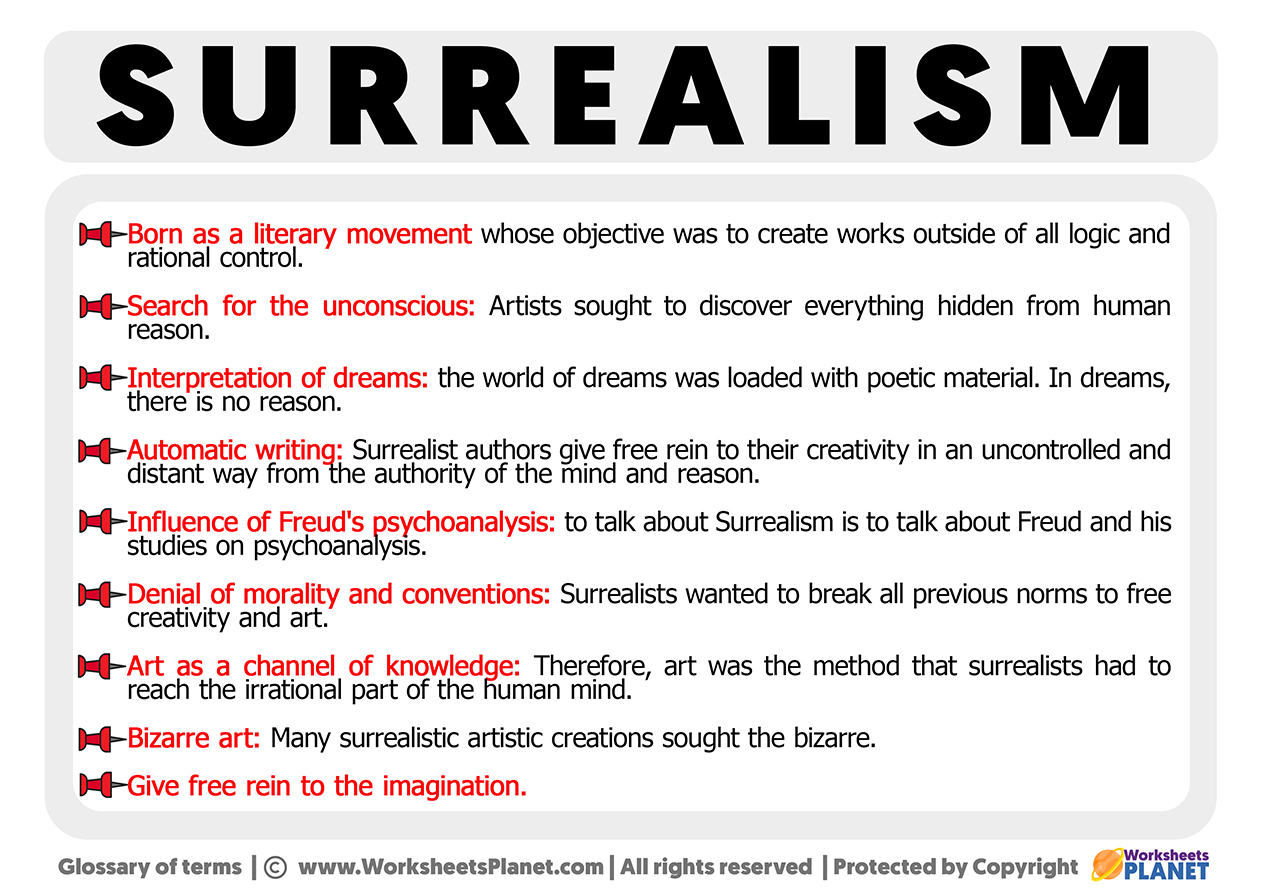
Surrealism was heavily influenced by Sigmund Freud, the father of psychoanalysis. You know, the guy who thought we all had a dark, repressed side that liked to play mind games with us. The Surrealists took this idea and ran with it, creating art that was as twisted as a pretzel and as confusing as a Rubik's cube.
They believed that art should be a way to explore the subconscious mind, to delve into the dark corners where our deepest fears and desires lurk. So, they painted dreamscapes that were as bizarre as a fever dream and as thought-provoking as a philosophy lecture.

Automatism: The Art of Accidental Genius
One of the Surrealists' favorite techniques was automatism, which is basically a fancy word for 'accidental genius.' It's like when you're trying to draw a cat, but it ends up looking like a blob with whiskers. Only, in the case of Surrealism, that blob with whiskers becomes a profound statement about the nature of reality.
Automatism involved letting your hand do the drawing while your brain took a nap. The idea was that by bypassing the conscious mind, you could tap into the subconscious and create something truly original. It's like when you're trying to write a report, but your pen starts drawing a picture of a squirrel wearing a top hat instead.
Collage: The Art of Cutting and Pasting
Another Surrealist technique was collage, which is basically the art of cutting and pasting. But these guys didn't just cut out pictures of kittens and puppies. No, they were more interested in creating bizarre, dreamlike images that would make a Rorschach test look tame.
They'd take images from magazines, newspapers, and even old books, and cut them out to create something new and strange. It's like when you're making a scrapbook, but instead of sticking in photos of your vacation, you're sticking in pictures of a man playing a violin with a spoon while a giraffe watches from the window.
Surrealism in Everyday Life
Surrealism wasn't just about painting weird pictures, though. It was a way of looking at the world, a way of finding the strange and wonderful in the everyday. It was like being on a never-ending treasure hunt, where the treasure was a new way of seeing things.
Take, for example, the Surrealist game of 'Exquisite Corpse.' It's like a game of telephone, but with drawing instead of whispering. One person draws a head, folds the paper to hide it, and passes it on. The next person draws the torso, folds the paper, and passes it on again. And so on, until you end up with a drawing that's as bizarre as it is beautiful.
Or how about the Surrealist dinner party? Imagine sitting down to a meal where the table is set with melting clocks, the walls are painted with giant lips, and the conversation revolves around the meaning of life and the nature of reality. It's like a dinner party hosted by the Mad Hatter, but with better wine.
Surrealism Today
Surrealism might have started in the early 20th century, but its spirit lives on today. You can see it in everything from fashion to film, from music to literature. It's in the dreamscapes of David Lynch, the fashion designs of Alexander McQueen, the music of Björk, and the novels of Haruki Murakami.
It's in the way we question reality, the way we look for the strange and wonderful in the everyday. It's in the way we dream, the way we think, the way we create. It's in the way we see the world, like a giant, bizarre, beautiful, and utterly surreal painting.
So, the next time you see something that makes you scratch your head and say, "What on earth is that?" remember, you're not just looking at a weird painting. You're looking at a piece of history, a piece of art, a piece of the surreal.