
What Is The History Of Surrealism
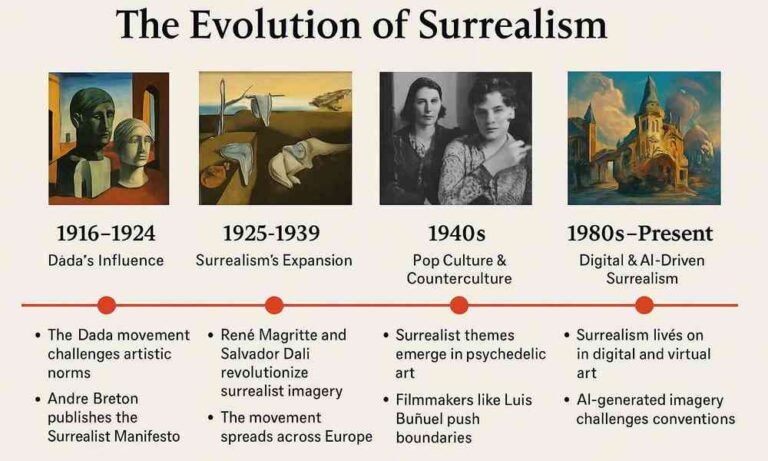
Alright, gather 'round, folks. It's story time, and today we're diving into the wacky world of Surrealism. Now, you might be thinking, "Surrealism? Isn't that just a fancy word for 'weird art'?" Well, you're not entirely wrong, but stick around, because this tale is stranger than a cat playing poker.
Once Upon a Time in the Early 20th Century...
Imagine, if you will, the bustling streets of Paris in the early 1900s. The city was a melting pot of artists, writers, and dreamers, all buzzing with ideas that would change the world. Among them was a group of artists who decided they'd had enough of the stuffy, traditional art scene. They wanted to paint what they saw in their dreams, not what they saw in the Louvre. And thus, Surrealism was born.
Now, you might be wondering, "Who was the mastermind behind this movement?" Well, that would be André Breton, a man who looked like he'd stepped straight out of a French New Wave film. He was a poet, a philosopher, and the self-proclaimed Pope of Surrealism. He wrote the Surrealist Manifesto, which was basically the rulebook for this new game of artistic anarchy.
Must Read
Rules? We Don't Need No Stinkin' Rules!
Breton's manifesto was a wild ride, filled with declarations like, "Surrealism is based on the belief in the superior reality of certain forms of association heretofore neglected, and in the omnipotence of dreams." In other words, these guys believed that dreams were more real than reality, and they wanted to paint what they saw in their sleep. No more still lifes or portraits of Great Aunt Mabel. It was time to paint the impossible.
But how do you paint the impossible, you ask? Well, Surrealists had a few tricks up their sleeves. One of their favorite techniques was automatism, which is just a fancy word for 'drawing while you're half-asleep.' They believed that by letting their pens wander freely, they could tap into their subconscious and bring forth images straight from their dreams.
Meet the Players
Now, let's introduce you to some of the Surrealists who made this movement what it is today. First up, we have Salvador Dalí, the most famous Surrealist of them all. Dalí was a Spanish painter who was known for his wild mustache, his even wilder paintings, and his claim that he could paint like a master at the age of ten. He was also known for his eccentric behavior, like the time he showed up to a lecture in a deep-sea diving helmet.

Then there was René Magritte, a Belgian artist who was famous for his witty, thought-provoking paintings. He once said, "The visible that is invisible, that is the supernatural." His most famous work, "The Treachery of Images," features a pipe with the words "Ceci n'est pas une pipe" (This is not a pipe) written beneath it. Talk about a mind-bender!
And let's not forget Frida Kahlo, the Mexican artist who was known for her vibrant, emotive self-portraits. While she's often associated with Surrealism, Kahlo preferred to call her work "magic realism." But whether she was a Surrealist or not, there's no denying that her art is just as dreamlike and captivating as any Surrealist painting.
Surrealism in Everyday Life
Surrealism wasn't just about painting weird stuff. It was a way of life. Surrealists believed in the power of dreams and the subconscious, and they tried to incorporate that into every aspect of their lives. They held séances, they experimented with drugs, and they even played a game called 'exquisite corpse,' where a group of people would take turns adding to a drawing, folding the paper to hide what the previous person had drawn. The result was often a hilarious, surrealist masterpiece.

Surrealism also had a big impact on pop culture. You can see its influence in everything from Alfred Hitchcock's films to the music of David Bowie. And let's not forget about those weird dreams you have after eating too much cheese before bed. Yep, you can thank Surrealism for that, too.
But Why?
So, why did Surrealism matter? Well, for one thing, it challenged the way we think about reality. It asked us to question what we see and to consider the power of our dreams. It was a rebellion against the stuffy, traditional art world, and it paved the way for future artists to break the rules and follow their own creative visions.
But more than anything, Surrealism was about having fun. It was about letting your imagination run wild and seeing where it took you. And isn't that what art is all about? So, the next time you find yourself staring at a painting of a melting clock or a pipe that's not a pipe, remember the Surrealists. They were just a bunch of dreamers who wanted to make the world a little bit weirder, and a little bit more wonderful.