
Harry Beck's London Underground Topological Map

When Harry Met the Tube: The Man Who Revolutionized London's Map
Picture this: it's 1931, and our hero, Harry Beck, is sitting at his desk, staring at a mess of lines and squiggles. He's not a doctor trying to decipher an MRI, nor an artist painting a masterpiece. No, Harry's just trying to make sense of the London Underground. And let's face it, that's a masterpiece in itself!
Beck's Brainwave
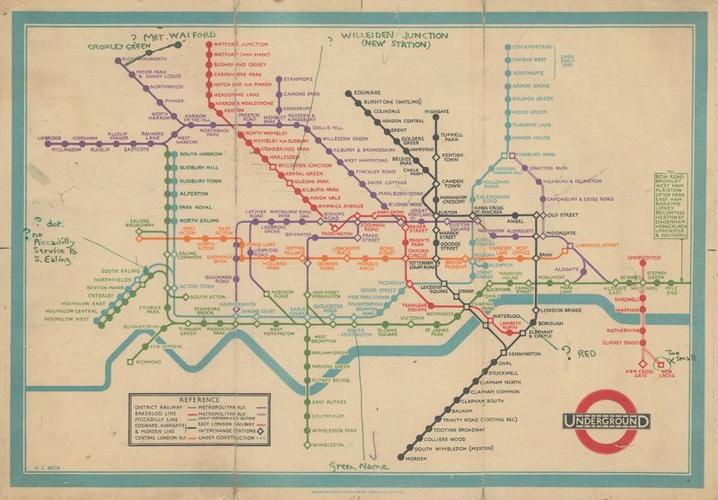
Now, you might think, 'How hard can it be to draw a few lines on a map?' Well, let me tell you, the original Underground map was about as useful as a chocolate teapot. It was a spaghetti junction of lines, with no rhyme or reason. But then, Harry had an idea. A genius idea. He thought, 'What if I treat the Underground like an electrical circuit?' And just like that, the topological map was born.
You know how in cartoons, when a lightbulb goes off above someone's head, it means they've had a brilliant idea? Well, in Harry's case, it should've been a whole string of lightbulbs. Because his idea was nothing short of a revelation. It was like he'd found the holy grail of map-making. Or, you know, the holy grail of tube-riding, at least.
From Circuit to Map
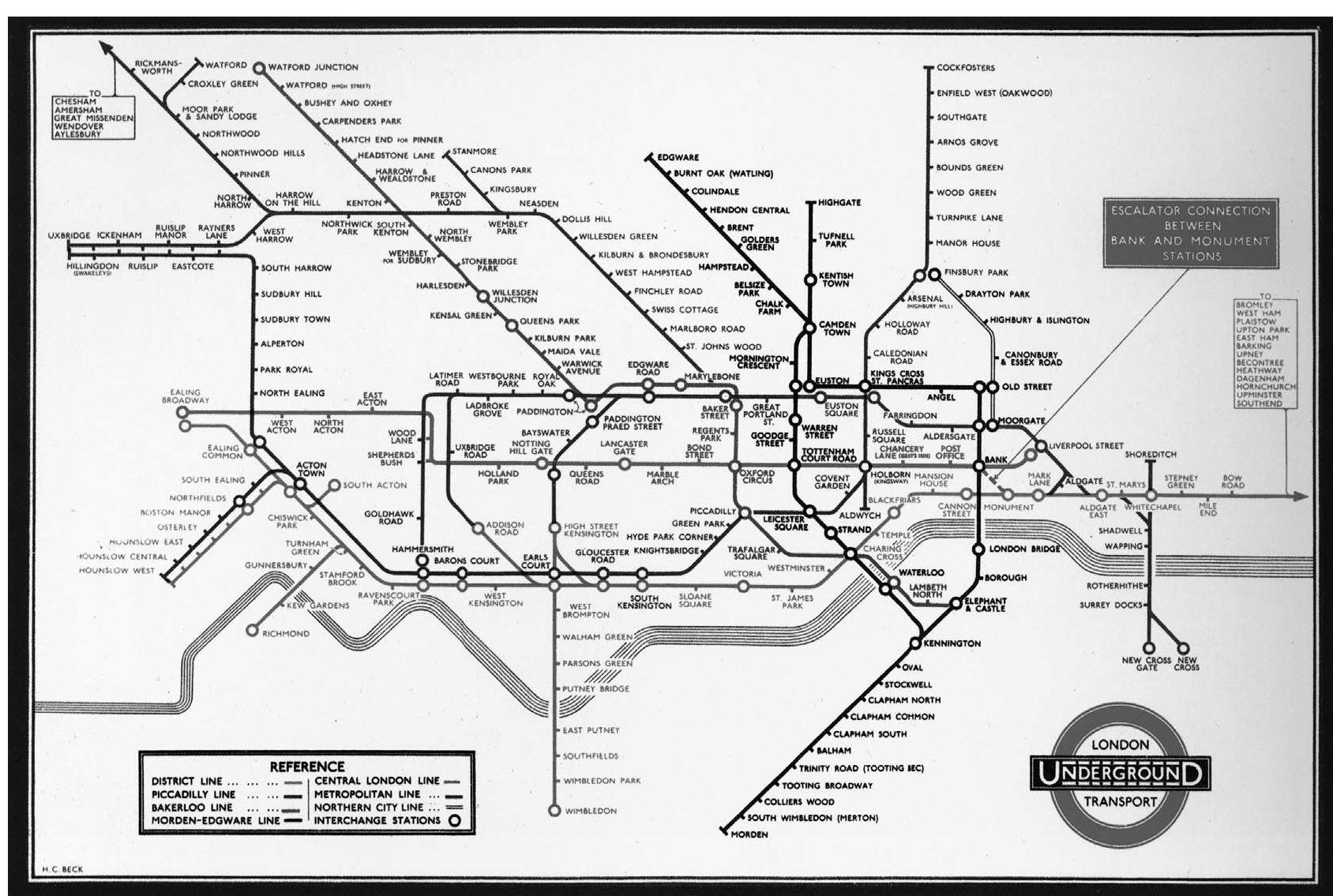
So, how did Harry turn his brainwave into a map that's as iconic as the Queen's crown? Well, he took those electrical circuits and turned them into straight lines and right-angled corners. He simplified stations into neat little circles, and made sure every line connected to every other line. It was like he'd taken the chaos of the Underground and turned it into a beautiful, logical dance.
And the best part? He did it all in his spare time. Yes, you heard me right. Harry wasn't some bigwig map-maker. He was just a humble engineering draftsman who loved a good puzzle. He took one look at that mess of a map and thought, 'I can do better than this.' And boy, did he!
From Paper to Platforms
Harry's first map was just a little thing, a small sheet of paper he handed out to his colleagues. But word got around, and soon, everyone was raving about this new, easy-to-understand map. The London Passenger Transport Board (that's a mouthful, right?) saw the potential and decided to give Harry's map a trial run on the platforms.
And guess what? It was a hit! People loved it. They could finally navigate the Underground without needing a degree in cartography. Harry's map was like a breath of fresh air in the smoggy streets of London. It was the underground equivalent of a lighthouse, guiding lost souls to their destinations.
Beck's Legacy
Harry's map wasn't just a hit with the public. It was a hit with the critics too. In 1933, just two years after he first drew it up, Harry's map won a prize at the Paris Exhibition. And that was just the beginning. His design has been tweaked and updated over the years, but the basic layout is still the same. It's still the same map that's guided millions of people through the labyrinthine depths of the London Underground.
Today, Harry's map is more than just a tool for getting from A to B. It's a symbol of London. It's a work of art. It's a testament to one man's ability to take a complex mess and turn it into something beautiful and simple. It's Harry Beck's legacy, and it's a bloody brilliant one at that.
So, the next time you're standing on the platform, waiting for the Northern Line to take you to your stop, spare a thought for Harry. He's the reason you can navigate the Underground without needing a compass and a prayer. He's the man who turned a chaotic mess into a thing of beauty. He's Harry Beck, the man who met the Tube and changed its life forever.